

Architecting Secure Data Flow Without Compromising the Purdue Model

As manufacturing and process industries pursue Industry 4.0 initiatives, the pressure to expose operational technology (OT) data to IT-layer analytics, ERP, and cloud platforms has outpaced the security architecture many facilities still rely on. This article reviews the Purdue Enterprise Reference Architecture as the baseline security model, examines why direct OT-to-cloud connectivity undermines it, and analyzes gateway-based architectures — including unidirectional and mediated bidirectional designs — as a practical path to convergence that preserves network segmentation
1. The Purdue Model and Why It Still Matters
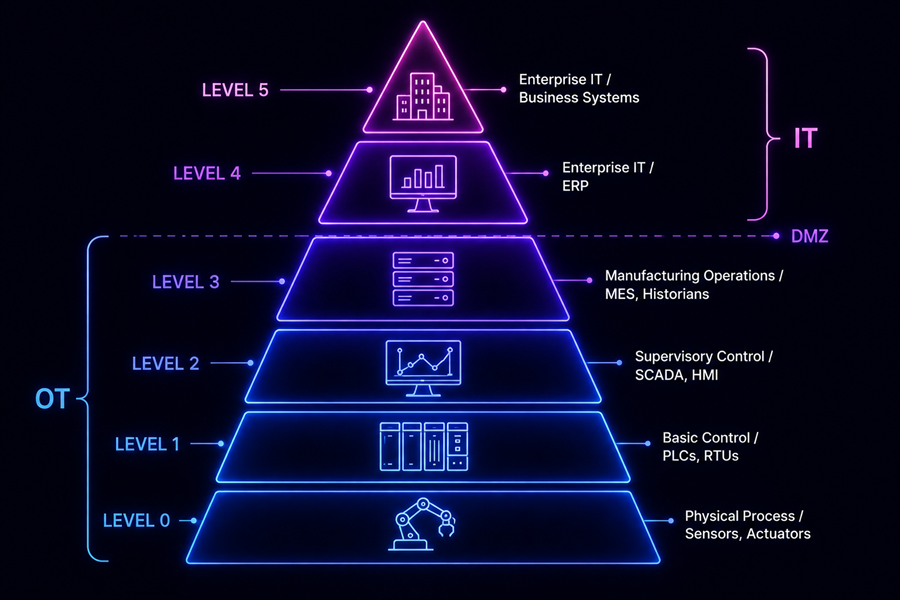
The Purdue Enterprise Reference Architecture (PERA), and its adaptation in ISA-95 and ISA/IEC 62443, has been the de facto reference model for industrial network segmentation for over two decades. It structures a facility into layers — from Level 0 (physical process) and Level 1 (basic control, PLCs/RTUs) through Level 2 (supervisory control, SCADA/HMI), Level 3 (manufacturing operations, MES/historians), a demilitarized zone (DMZ), and Levels 4–5 (enterprise IT, ERP, and business systems).
The model’s core security value is not the layering itself but the “enforced boundary” between OT (Levels 0–3) and IT (Levels 4–5): control-layer traffic should never route directly to or from the enterprise network without passing through a mediated, monitored DMZ. ISA/IEC 62443, the primary standard governing industrial automation and control systems (IACS) security, formalizes this boundary through the concept of security zones and conduits, requiring that any data conduit crossing a zone boundary be explicitly identified, risk-assessed, and controlled.
The practical problem is that Industry 4.0 initiatives – predictive maintenance analytics, cloud historians, ERP-integrated production data, remote asset monitoring — all require exactly the kind of Level 0–3 to Level 4–5 data flow the Purdue model was designed to control, not eliminate. The convergence pressure is real and not going away; the architectural question is how to satisfy it without collapsing the boundary that PERA and ISA/IEC 62443 exist to enforce.
2. Why Direct Connectivity Is the Wrong Default
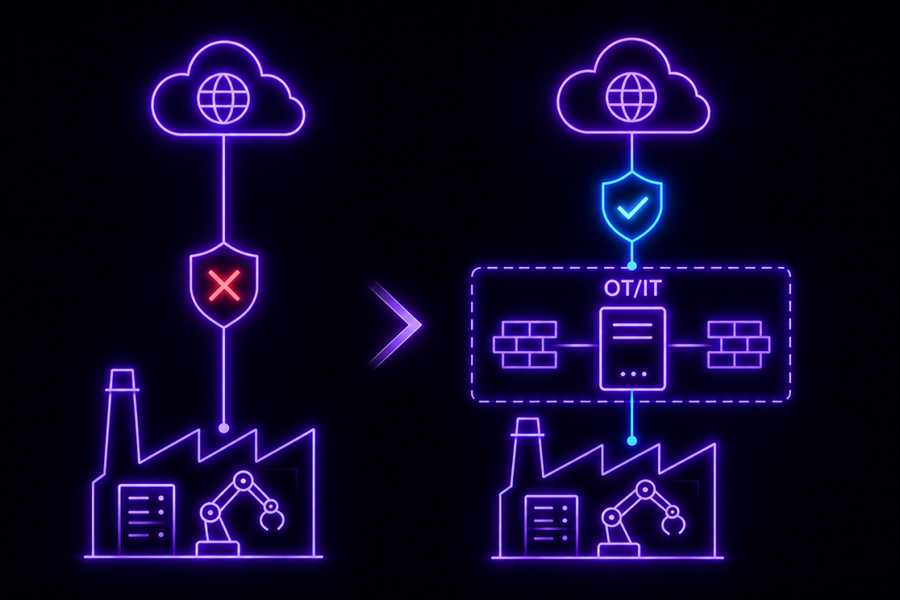
The most common failure mode in OT/IT convergence projects is what security assessments frequently describe as “boundary erosion”: a PLC or historian is given a route — sometimes officially sanctioned, often informal — directly to a cloud endpoint or IT-layer application, bypassing the DMZ entirely. This typically happens incrementally: a single analytics pilot needs a data feed, a firewall rule is opened as a temporary measure, and the temporary measure persists because reversing it would break a now-dependent downstream process.
The risk this introduces is well documented in ICS security literature and incident post-mortems: a control-layer asset with a direct route to the internet or to enterprise IT inherits IT-layer attack surface (phishing-originated lateral movement, credential compromise, vulnerable IT-layer software) without the compensating controls IT environments are built to have (patching cadence, endpoint detection, network monitoring tuned for IT traffic patterns). Control-layer devices are frequently unpatched for long periods by necessity — availability requirements in process environments often preclude the patch cadence normal in IT — which makes direct exposure disproportionately risky relative to the equivalent exposure of an IT asset.
3. Gateway-Mediated Architectures
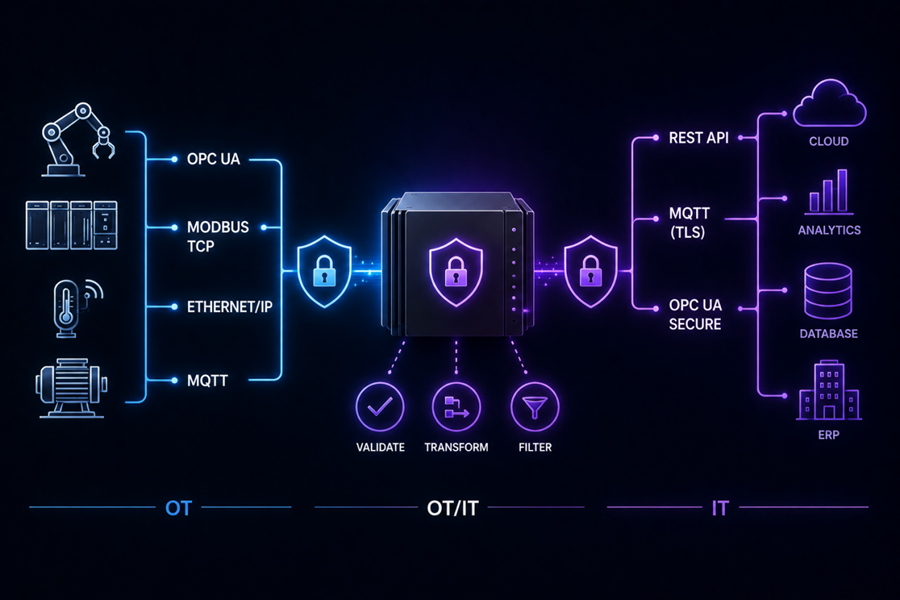
The architectural pattern that satisfies both the convergence requirement and the ISA/IEC 62443 zone/conduit model is a **mediated gateway deployed at or adjacent to the DMZ**, functioning as the sole authorized conduit between OT and IT layers. Several design variables differentiate implementations:
3.1 Protocol translation at the boundary.
Rather than routing native OT protocols (Modbus, EtherNet/IP, proprietary vendor protocols) into the IT network, the gateway terminates OT-side connections locally and re-publishes data using IT-native protocols and formats (REST APIs, MQTT with TLS, OPC UA with its built-in security model) on the IT side. This ensures IT-layer systems never establish a direct protocol-level session with a Level 0–2 device.
3.2 Data validation and sanitization.
A well-architected gateway does not perform a transparent pass-through; it validates, transforms, and filters data against a defined schema before publication, both reducing the risk of malformed or malicious payloads propagating upstream and ensuring only the tags actually needed for a given IT-layer use case are exposed — a practical application of the least-privilege principle at the data layer, not just the network layer.
3.3 Directionality.
For the highest-assurance use cases — safety instrumented systems, critical infrastructure — unidirectional gateways (data diodes) provide a hardware-enforced, physically one-way data path from OT to IT, eliminating any possibility of a return path regardless of software configuration. For the broader set of convergence use cases (dashboards, analytics, ERP integration, remote monitoring) where some bidirectional interaction is operationally necessary — remote parameter adjustment, acknowledgment workflows — a mediated bidirectional gateway with strict protocol translation, authentication, and logging at the boundary is the more common and more flexible pattern, provided it is deployed at the DMZ and not used to justify collapsing the DMZ itself.
3.4 No-code/low-code configurability as a security-relevant property.
An underappreciated aspect of gateway architecture is how change management interacts with security posture. Gateways requiring custom code for each new data mapping create pressure to batch changes and defer patching/testing cycles; visually configured, no-code mapping and transformation layers reduce the engineering lead time for legitimate connectivity changes, which in practice reduces the incentive for the informal, unauthorized “temporary” direct connections that erode the boundary in the first place.
4. Practical Deployment Considerations
Three considerations recur across successful convergence architectures:
4.1 Placement matters as much as function.
A gateway deployed at Level 3.5 (the DMZ, per ISA-95/Purdue terminology) preserves the zone/conduit model. The same gateway software deployed inside Level 2/3 with a direct route out to the internet reproduces the exact boundary erosion problem it was meant to solve — the technology choice does not substitute for correct network placement.
4.2 Edge deployment reduces latency and attack surface simultaneously.
Running the gateway function on dedicated edge hardware co-located with the control equipment, rather than routing raw OT data to a remote or cloud-hosted mediation layer, keeps latency-sensitive data local and reduces the amount of unmediated OT traffic that ever traverses a WAN link.
4.3 Auditability is a deployment requirement, not an afterthought.
ISA/IEC 62443’s conduit model assumes logged, monitorable traffic at zone boundaries. Gateway deployments should be evaluated on logging and audit capability at the same level of scrutiny as throughput and protocol coverage.
5. Conclusion

OT/IT convergence is not optional for facilities pursuing Industry 4.0-scale analytics, and the pressure to connect control-layer data to enterprise systems will continue to grow. The architectural question worth resolving deliberately, rather than incrementally through firewall exceptions, is *where* that connection happens and *what mediates it*. A gateway deployed at the DMZ boundary, performing protocol translation, data validation, and — where warranted — enforced unidirectional flow, allows facilities to realize convergence benefits while keeping the zone/conduit model intact rather than quietly dismantling it one exception at a time.
Now that you know why secure data transfer matters, the next question is: how can you achieve it without unnecessary cost or complexity?
Secure data transfer shouldn’t be complicated. See how you can keep your data protected at a fair price — with no hidden fees and no unnecessary features. Discover our solution:
—
**References for further reading:** ISA/IEC 62443 series, *Security for Industrial Automation and Control Systems*; ISA-95 / IEC 62264, *Enterprise-Control System Integration*; NIST SP 800-82 Rev. 3, *Guide to Operational Technology (OT) Security*.
Leave a Reply